Every buyerbecomes a billboard.
The Seller | The unlikely winner
Imagine not knowing where your next dollar is coming from. The bills are due, the plan didn’t work, and nobody is coming to save you. So you pick up your phone, prop it against whatever’s nearby, and hit record.
That’s how a lot of launches like the ones on these tiles start. Not in a studio. Not with a team. With someone who doesn’t look like the people we’re used to seeing win online, talking live to camera and figuring it out in real time.
And that’s exactly why they win. Most people believe you have to have it all figured out before anyone will buy from you. These sellers prove the opposite. They don’t have it figured out, they say so out loud, and everyone else who doesn’t have it figured out finally sees someone like them winning.
Then they do what most experts never do: they ask. They let their audience tell them what they want, and they build exactly that. The audience doesn’t just watch the product get made. They shape it. So by the time it launches, it already belongs to them.
Relatable isn’t a demographic. It’s a circumstance.
What these sellers share isn’t a life stage, a look or a title. It’s a circumstance that millions of people are living through right now: starting over, figuring it out, refusing to wait until they’re ready.
That’s the move. Take an inventory of your own life, then ask a bigger question: which of my circumstances do the most people share?
The bigger that last number, the bigger your market. Relatability isn’t a personality trait. It’s a market-sizing decision.
But big isn’t the only way to win. Some operators want thousands of buyers. Others want a short list of the right ones, the clients who open doors money alone can’t. Same system, two outcomes: mass or access. Your goal decides which.
The Buyers | They do it in public
Here’s what most people miss. The sales page didn’t sell these launches. The participants did. Buyers used the product out loud: their first edit, their first trial reel, their first sale. Nobody asked them to. They were part of something, so they showed off.
Every one of those posts was proof, and proof spreads. People watched strangers get results in real time and wanted the same thing, so they bought. Then they posted. Then more people bought.
The product wasn’t the marketing. The buyers were.
The Product | Seen using it
That’s the lesson. If buyers can’t be seen using what you sell, you do all the marketing yourself. If they can, every customer becomes a billboard. A challenge, an edit style, a reel format, a system with visible output: those travel on their own.
Compare that with something nobody can see. A spreadsheet, a mindset course, a private call: the buyer might love it, but there’s nothing to post. So the seller has to create demand from scratch, every single day.
The Launch | The launch rhythm
Every launch on this page ran the same five beats, and every one of them shared the numbers.
Through all of it, trial reels and stories did the heavy lifting: trial reels to reach strangers who had never heard of them, stories to turn the people already watching into buyers.
The Spread | The numbers go viral
Then something happened that no launch plan can schedule. The creators posted their first launch numbers, and the internet started talking about the numbers instead of the product.
Think pieces asked whether the numbers were real. Hot takes called it a bubble. Reaction videos did the math on camera, stitches tried the product for a week, podcasts and threads broke the launch down line by line. Almost every one of them named, showed or linked the original launch.
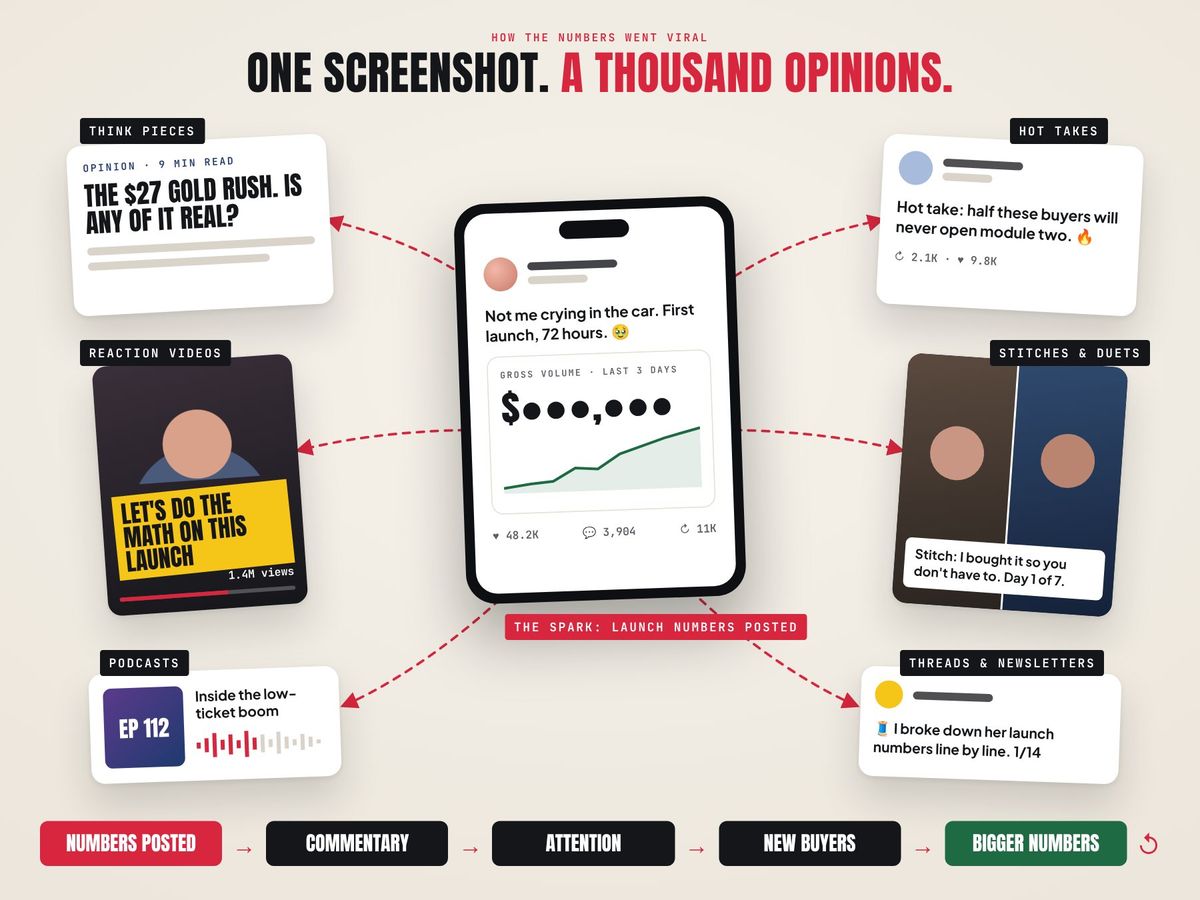
Every new opinion was free distribution. People who would never have seen a video-editing course now knew its name, its price and its revenue. Plenty were skeptical. Plenty bought anyway, just to find out for themselves. And when the next numbers came in, the cycle started again.
The Psychology | The psychology underneath
Underneath the tactics, the same six forces did the selling. None of them are new. What’s new is how fast they move when thousands of buyers are posting at once.
“She’s like me.” Buyers weren’t buying a course. They were buying who they’d become.
Strangers’ results did what no testimonial page can. Proof you watch happen beats proof you’re told about.
Buying made you a participant. Posting made you part of the group.
Waitlist, early bird and cart close put a clock on the decision.
Your first win, posted, made you someone with a win.
Big numbers made people need to see it for themselves.
Notice what isn’t on the list: the quality of the lesson. The psychology sold the product before anyone had opened it.
The Gap | The gap
AI made the making cheap. An edit that took a pro an hour takes a beginner ten minutes. A month of content takes an afternoon. Overnight, millions of people could suddenly make things they couldn’t make last year.
That’s the money gap. The cost of creating collapsed, but the value of attention didn’t. So a new market opened: people who could finally make things, buying low-ticket systems from people who already had attention.
But the gap has a second side. Knowing how to make something is not the same as getting paid for it.
✓The steps
✓The template
✓A login
→An audience that trusts you
→Timing, before the trend peaks
→Months of reps nobody films
The Downside | The downside nobody posts
Here’s the part the screenshots leave out. A how-to is a map, not the trip. Buying the course got thousands of people the steps. It didn’t get them the audience, the timing, or the year of posting the seller had before the launch.
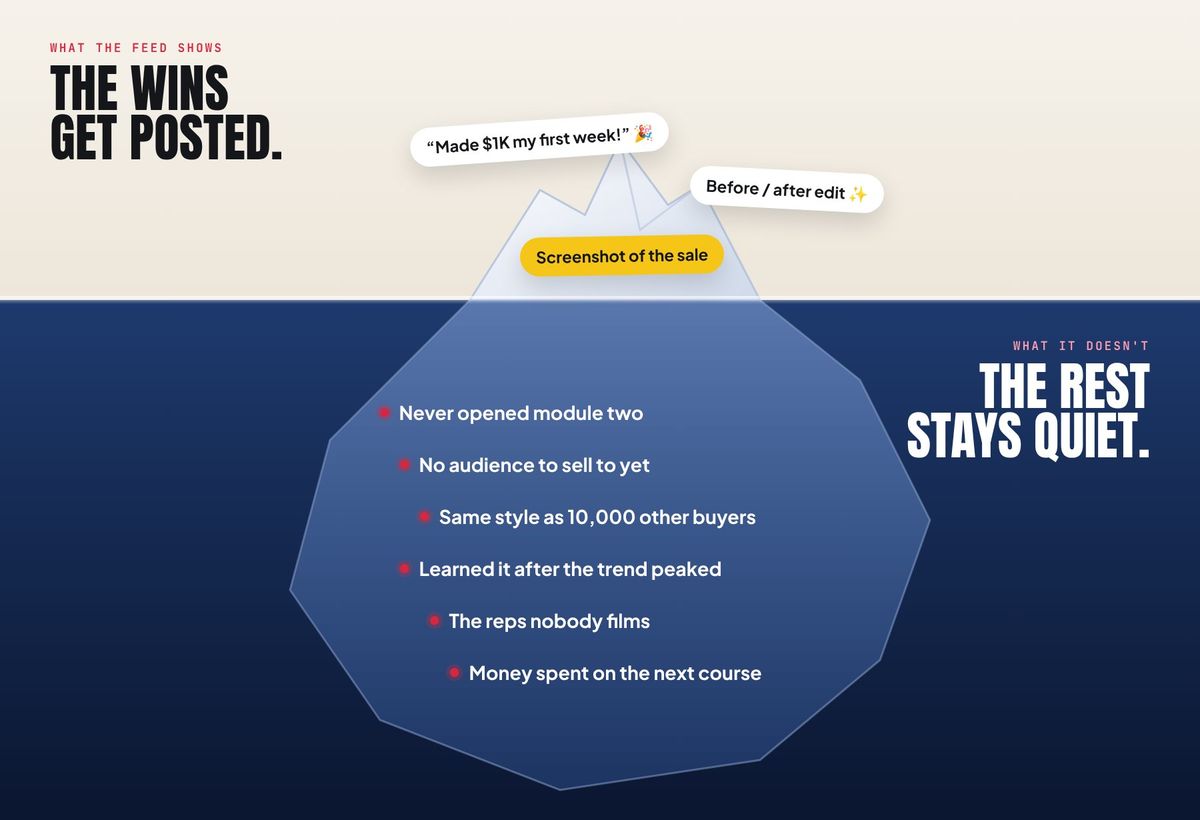
For every buyer who posted a win, there were buyers who never opened module two. You don’t see their posts, because there’s nothing to post. The feed only shows the people it worked for.
And there’s a quieter cost. When thousands of people learn the same edit style in the same month, the style stops being special. The first wave gets the attention. Everyone after them is copying a copy.
Not every launch delivered what its sales page promised, either. When buyers say that publicly, we report it, with the receipts. When they don’t, we don’t guess.
Learning how is the cheap part. Being early, being seen and doing the reps is the expensive part.
Our Read | The Breakkdown
Strip away the personalities and every launch here ran on the same engine:
Miss one part and the engine stalls. Most people who try to copy these launches copy the product and skip the other five.
The Opportunity | The opportunity
So where’s the money? Not in one more how-to. The real money sits in what happens after the lesson: building something people can be seen using, launching it on a rhythm, and planning for the numbers to travel.
And there’s a second opportunity most people miss: the commentary itself. Every think piece, reaction and breakdown in section 05 earned attention from someone else’s launch. Explaining what happened, and why, is its own business.
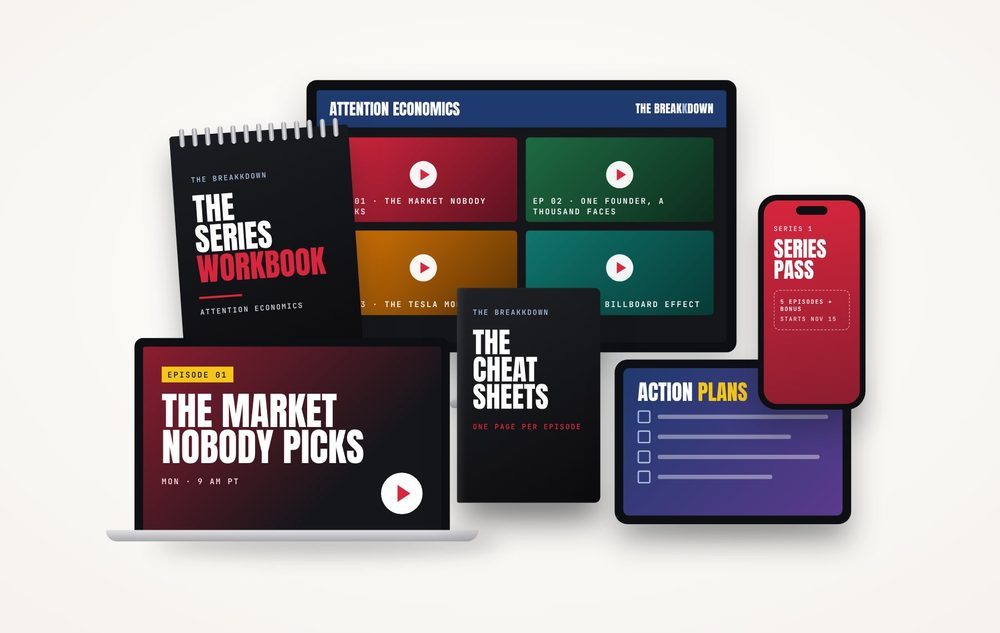
That’s the brief. Attention Economics goes underneath it: the market nobody picks, the thousand faces, the first product, the billboard, the store that never closes, and the primal moment people buy in.
The Series | What the series shows you
Everything above is what’s happening on the surface. Attention Economics is what’s happening underneath it, and where it goes next.
Every episode is built on what I’m seeing in the market right now: the shifts, the gaps, and where the money is moving next. Not theory. Not another course. Intelligence you can act on the same day.
And on the last day, I’m showing you what I’ve been building.
The Reveal | What I’ve been building
Understanding the market is half of it. The other half is showing up for your number every single day. Most entrepreneurs don’t look at the metric that matters most until it’s too late: revenue and profit.
So I built a platform that does both. It helps you read the market, and it holds you accountable, every day, to the two numbers that decide whether your business lives: what came in, and what you kept.
And it isn’t only software. Access is part of what I’m building: a private network of rooms, introductions and curated events, for operators who want their next clients to come through the right doors.
When it launches, I’m opening it to a small, select group first: founders who will test it, push it and tell me the truth. Series Pass holders are first in line.
Read the market. Make your number. Every day.
From Ambitious | Why I see it first
For more than 15 years, I’ve worked behind the scenes with athletes, entertainers, celebrities, business executives and Fortune 100 companies. My job was to see what was coming before anyone else did, and help them build for it.
I see where markets are going five to ten years before they get there. I see where industries are about to collide, and the gaps that open when they do. That’s where exponential opportunity lives, and I’ve spent my career pointing other people toward it.
For the last seven years, I’ve been looking for my voice. I found it.
This is the first time I’m taking everything I know and building something big for myself. I’m not going to whisper it, and I’m not going to apologize for it. This series is the first look.